SpaceTimeFabric Class
The SpaceTimeFabric class is designed to visualize the effects of gravitational fields on a space-time fabric. This class can be used in various scenarios to illustrate gravitational interactions and distortions caused by massive objects.
Overview
The SpaceTimeFabric class takes parameters to define the ranges and resolution of the fabric, allowing for dynamic visualizations of gravitational effects in a 3D environment.
Parameters
u_range (tuple): Specifies the range of the u-axis.
v_range (tuple): Specifies the range of the v-axis.
resolution (tuple): Defines the resolution of the grid used to create the fabric.
t_range (tuple): Specifies the range of time values for the animation.
scaling_factor (float): Scales the visual representation of the fabric.
func (function): Function to compute the gravitational potential based on object positions.
func_args (tuple): Additional arguments to be passed to the func function.
Examples
Illustration of Space-Time Fabric Distortion by a Star
This example demonstrates how the presence of massive objects, like stars, distorts the space-time fabric.
from manim import *
import numpy as np
from manim_Astronomy.stellar_objects import *

def gravitational_potential(u, v, mass_positions, masses):
    G = 1
    potential = 0
    epsilon = 0.1
    for i in range(len(mass_positions)):
        mass_posu, mass_posv, mass_posz = mass_positions[i]
        M = masses[i]
        r = np.sqrt((u - mass_posu)**2 + (v - mass_posv)**2 + mass_posz**2)
        if r < epsilon:
            r += 0.05
        potential += -G * M / r
    return potential

class SpaceTimeFabricDistortionByAStar(ThreeDScene):
    def construct(self):
        mass1 = Dot3D(point=[0, 0, 0.3], radius=0.3)
        mass2 = Dot3D(point=[1.1, 0, 0], radius=0.05)
        fabric = SpaceTimeFabric(
            u_range=(-2, 2),
            v_range=(-2, 2),
            resolution=(50, 50),
            t_range=(-2, 2)
        )
        self.add(fabric)
        self.move_camera(phi=70 * DEGREES, theta=-90 * DEGREES)
        self.wait(3)

        def fabric_updater(mob):
            mob.become(SpaceTimeFabric(
                u_range=(-2, 2),
                v_range=(-2, 2),
                resolution=(50, 50),
                t_range=(-2, 2),
                scaling_factor=0.01,
                func=gravitational_potential,
                func_args=([mass1.get_center(), mass2.get_center()], [50, 2])
            ))
        fabric.add_updater(fabric_updater)
        self.play(FadeIn(mass1, mass2))
        self.wait(3)
        self.wait(10)

Illustration of Black Hole Merger Distorting Space-Time Fabric
This example demonstrates the merging of two black holes, that spiral towards each other, affecting the surrounding space-time fabric.
from manim import *
import numpy as np
from manim_Astronomy.stellar_objects import *

def gravitational_potential(u, v, mass_positions, masses):
    G = 1
    potential = 0
    epsilon = 0.1
    for i in range(len(mass_positions)):
        mass_posu, mass_posv, mass_posz = mass_positions[i]
        M = masses[i]
        r = np.sqrt((u - mass_posu)**2 + (v - mass_posv)**2 + mass_posz**2)
        if r < epsilon:
            r += 0.05
        potential += -G * M / r
    return potential

class BlackHolesMerger(ThreeDScene):
    def construct(self):
        mass1 = Dot3D(point=[-1, 0, 0], radius=0.1, color=BLACK)
        mass2 = Dot3D(point=[1, 0, 0], radius=0.1, color=BLACK)
        masses = VGroup(mass1, mass2)
        merged_mass = Dot3D(point=[0, 0, 0], radius=0.15, color=BLACK)
        fabric = SpaceTimeFabric(
            u_range=(-2, 2),
            v_range=(-2, 2),
            resolution=(50, 50),
            t_range=(-2, 2),
            scaling_factor=0.01,
            func=gravitational_potential,
            func_args=([mass1.get_center(), mass2.get_center()], [50, 50])
        )
        self.add(fabric, mass1, mass2)
        self.move_camera(phi=70 * DEGREES, theta=-90 * DEGREES)

        def fabric_updater(mob):
            mob.become(SpaceTimeFabric(
                u_range=(-2, 2),
                v_range=(-2, 2),
                resolution=(50, 50),
                t_range=(-2, 2),
                scaling_factor=0.01,
                func=gravitational_potential,
                func_args=([mass1.get_center(), mass2.get_center()], [50, 50])
            ))
        fabric.add_updater(fabric_updater)

        def update_mass1(mob, dt=1):
            x, y, _ = mob.get_center()
            r = np.sqrt(x**2 + y**2)
            theta = np.arctan2(y, x)
            dr = -0.1 * dt
            dtheta = -2 * dt / r
            r += dr
            theta += dtheta
            mob.move_to([r * np.cos(theta), r * np.sin(theta), 0])

        def update_mass2(mob, dt=1):
            x, y, _ = mob.get_center()
            r = np.sqrt(x**2 + y**2)
            theta = np.arctan2(y, x)
            dr = -0.1 * dt
            dtheta = 2 * dt / r
            r += dr
            theta += dtheta
            mob.move_to([r * np.cos(theta), r * np.sin(theta), 0])

        mass1.add_updater(update_mass1)
        mass2.add_updater(update_mass2)
        self.wait(10)
        self.play(ReplacementTransform(masses, merged_mass))
        self.wait(10)
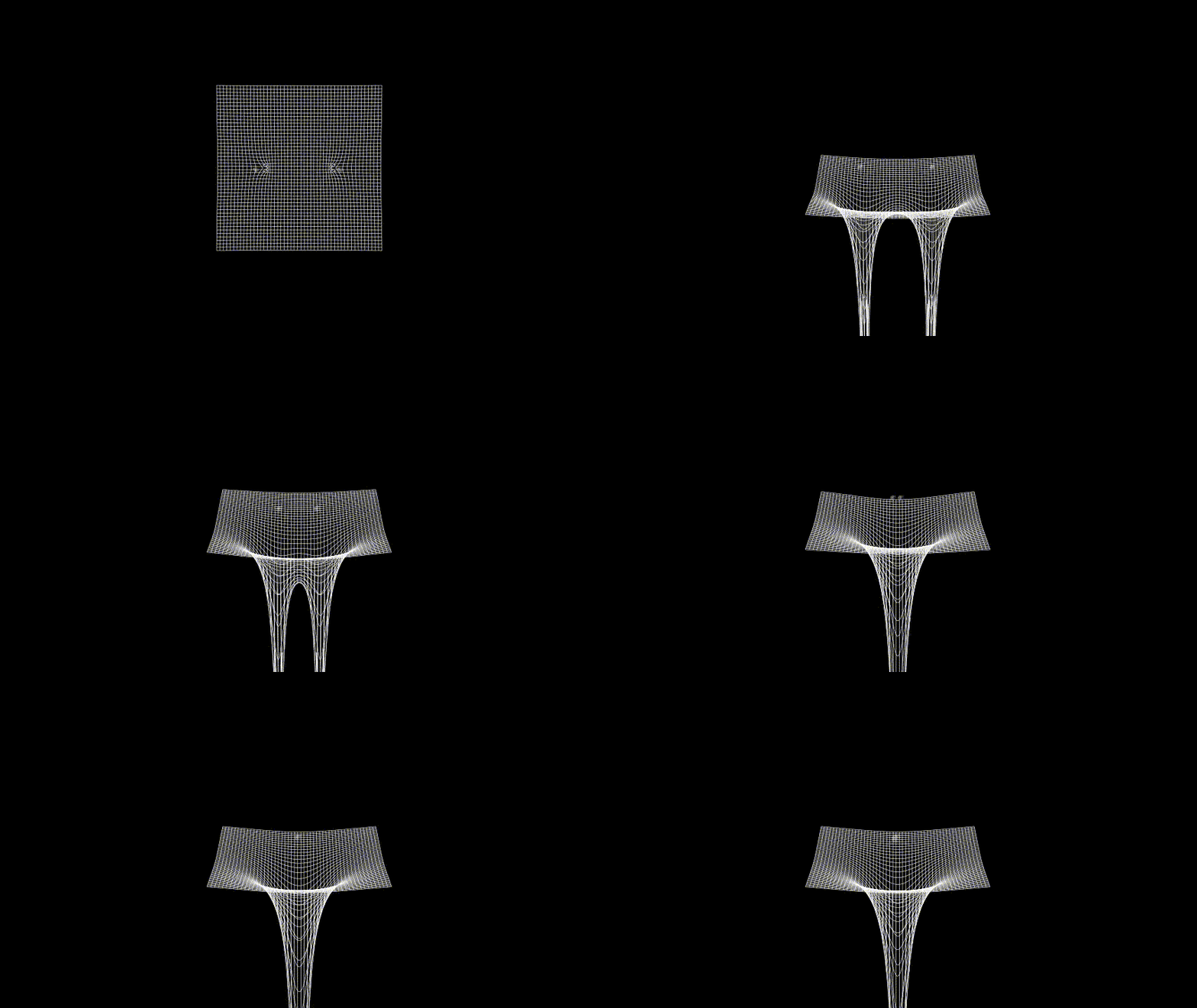
Illustration of Gravitational Waves After Black Hole Merger
This example demonstrates how gravitational waves ripple through space-time after two black holes merge, simulating the wavefronts created by the massive collision.
import numpy as np
from manim import *
from manim_Astronomy.stellar_objects import *

def wave_function(u, v, t):
    wavelength = 0.5
    amplitude = 0.2
    distance_from_center = np.sqrt(u**2 + v**2)
    return amplitude * np.sin(2 * np.pi * (distance_from_center - t) / wavelength)

class GravitationalWaves(ThreeDScene):
    def construct(self):
        merged_masses = Dot3D(point=[0, 0, 0], radius=0.15, color=BLACK)
        fabric = SpaceTimeFabric(
            u_range=(-2, 2),
            v_range=(-2, 2),
            resolution=(50, 50),
            t_range=(-2, 2),
            scaling_factor=0.1,
        )
        self.set_camera_orientation(phi=70 * DEGREES, theta=-90 * DEGREES)
        self.add(fabric, merged_masses)
        self.wait(1)
        t_tracker = ValueTracker(0)

        def update_fabric(mob):
            t = t_tracker.get_value()
            mob.become(SpaceTimeFabric(
                u_range=(-2, 2),
                v_range=(-2, 2),
                resolution=(50, 50),
                scaling_factor=0.1,
                t_range=(-2, 2),
                func=wave_function,
                func_args=(t,)
            ))

        fabric.add_updater(update_fabric)
        self.play(t_tracker.animate.increment_value(5), run_time=10, rate_func=linear)
        self.wait(2)
